Solar Power and Batteries
Important notice for homeowners with solar and/or battery systems.
Starting August 2025, Enefit will discontinue installation of solar power systems, sale of batteries, and related services to private customers. New client requests for these services will no longer be accepted. Existing customers with installed equipment will continue to receive warranty and maintenance services under the terms of their current contracts.
Although new installations will no longer be offered, solar power remains one of the most efficient sustainable energy options. Over time, the investment in a solar system pays off through lower electricity bills and reduced dependence on the energy market.
Looking for a reliable electricity provider? Explore our electricity plans!
APVA Support for Solar Power in 2025
Homeowners planning a new solar system or upgrading an existing one can still apply for APVA support. This financial assistance is available for systems up to 10 kW, including smaller capacities such as 5 kW. Total available funding is under 6 € million, and current subsidy rates are:
- 255.07 € per kW for new installations
- 191.16 € per kW for capacity upgrades
Funding for solar parks from remote sites has over 5 € million allocated; the remaining pool is over 800,000 €.
Who qualifies?
Residents who already have a solar system installed or upgraded to the required capacity, and who hold all necessary documentation, are eligible.
Each application may only cover a single electricity consumption point (address). If your solar system supplies multiple addresses, a separate application is required for each.
Equipment Requirements:
- Solar modules: must comply with EU standards, carry CE marking, provide at least 10 years of warranty and 25 years of at least 80% efficiency
- Inverter: CE marked, with ≥ IP65 rating and 5-year warranty

How to apply for APVA support?
Applications are submitted via the APVA system “APVIS” and must include all required documents. For more detailed steps and documentation requirements, visit the APVA website.
Solar Installed - What’s Next? Battery Storage
After your solar system is in place, adding battery storage is a logical next step. A battery stores surplus solar energy for later use - such as during high-rate hours or power outages - offering greater autonomy and efficiency.
Our smart management solution automatically tracks:
Your household electricity usage patterns
Market electricity prices
Hourly grid rates (starting from October 1, the Nord Pool power exchange will move to 15-minute time intervals.
When rates are low, the system charges - or stores - the battery. When rates rise, it uses the stored energy for consumption, helping you maximize the benefits of solar generation.
Year-Round Benefits
A battery is useful not only when there is plenty of sunlight — it also stores cheaper electricity from the grid at night and supplies power during peak hours when electricity is more expensive. It ensures an uninterrupted supply even during grid outages.
Even when the sun isn't producing electricity, the battery stores energy from the grid during low-cost periods and lets you use it when prices rise.
Tailored to You
The system adapts to your household’s electricity consumption habits.
Remote Battery Monitoring and Control
To maximize benefits, it’s smart to manage the battery based on your energy usage patterns, the capacity of your solar power system, and market electricity prices.
For example, using stored solar energy during peak hours - when electricity prices and grid charges are highest - is the most efficient approach.
Net-Billing Model
Want full involvement in energy generation, usage, and grid balancing?
Enefit clients can opt into the net-billing model, allowing efficient energy export and import with the grid. Learn more about how it works.
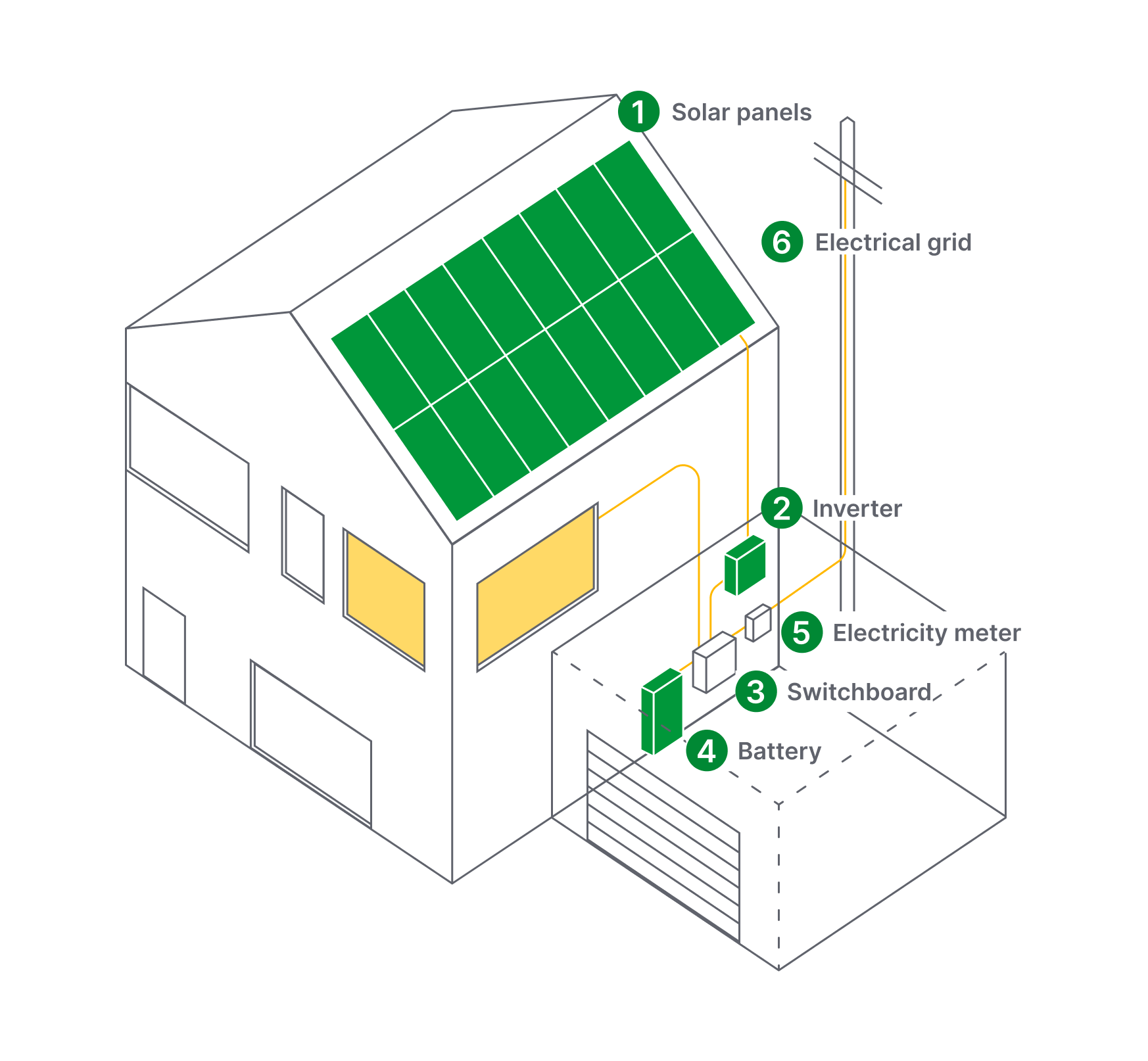
How the Solar + Battery System Works
- Solar panels (modules): capture sunlight and convert it into electrical energy.
- Inverter: transforms direct current (DC) from panels or battery into alternating current (AC) for home use.
- Distribution board: directs solar energy into the home’s electrical system.
- Battery: stores excess energy for later use or backup power.
- Electric meter: tracks electricity bought from or fed into the grid.
- Grid connection: enables energy consumption from and export to the public network.
The entire setup - solar panels, inverter, battery, and infrastructure - forms a solar system designed for efficient daily use of solar energy.